New Provincial Property Tax System
Beginning in 2027, the Government of Alberta will change how provincial education property tax is calculated. Rates will be fixed for three-year cycles, with the same rate applying across Alberta to every residential property and the same rate for every business property.
Click the blue boxes to learn more.
Under the old system, the province would tell each municipality an exact amount of tax that needed to be collected from local property owners. This was called an education tax requisition, and it involved several steps to calculate.
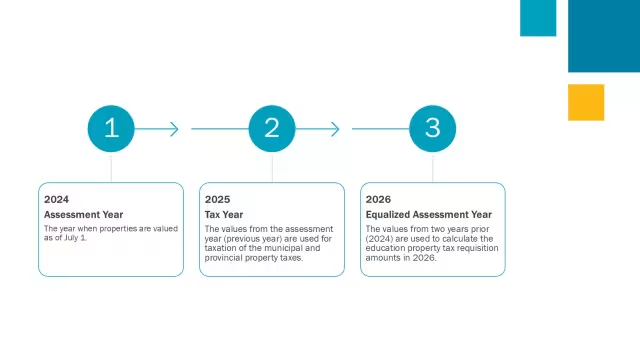
- Every year, the province uses a process called ‘equalized assessment’ to ensure the assessments of every municipality are done to a common standard. The province audits the property assessment values from two years earlier. If needed, it adjusts those values to full market value so property assessments can be compared fairly across municipalities. The result is a published list of the equalized assessment for each municipality.
- The province used these equalized assessments to decide how much education property tax must be collected by each municipal government. This was called an education tax requisition.
- Each municipality then used its current taxation year assessments to calculate the local education tax rate needed to collect the tax amount required by the province.
- Because equalized assessment values are one year older than the tax year assessments and those values may have been adjusted through the province’s audit, the education property tax rate shown on property tax bills varied by municipality.
This graphic explains the timing difference between when properties are assessed and when that data is used to create the equalized assessment.
The challenge with the old system is:
- Albertans were often confused why the province’s published tax rate was different from the rate they were charged on their property tax bill.
- Properties of the same value would pay a different amount of provincial property tax, depending on the community they were in.
- Since local councils were required to approve the local tax rate needed to collect the province’s education tax requisition, it made it appear that municipal councils set the education tax rate, even though the province determined how much education property tax must be collected. As a result, municipal leaders were often blamed for increases in provincial taxes.
The reason equalized assessment was used to calculate provincial property taxes is complicated. To learn more, read ABmunis’ Property Assessment and Taxation: A Guide for Alberta’s Municipal Leaders.
- The province will no longer use equalized assessments to tell each municipality how much education property tax to collect.
- Instead, the province will set one education property tax rate that every municipality will charge directly to each property, based on current taxation year assessments.
- The rates for provincial education property tax for 2027, 2028, and 2029 will be:
- $2.65 per $1,000 of assessment for residential and farmland properties, and
- $3.975 per $1,000 of assessment for non-residential properties.
- Municipalities will still be required to issue the tax notice and collect the education property tax on behalf of the Government of Alberta.
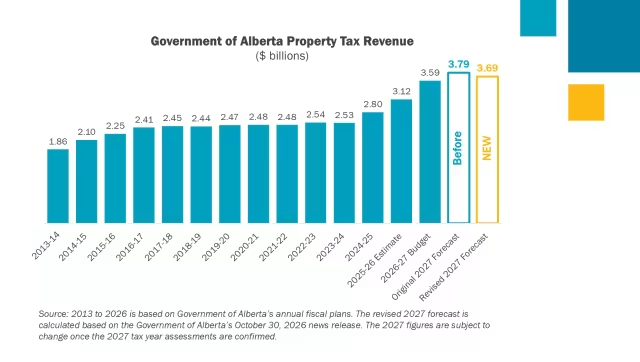
It will go up. In Budget 2026, the Alberta government forecasted that provincial property tax revenue would increase from $3.59 billion in 2026 to $3.79 billion in 2027, a 5.6 per cent increase.
As of October 30, 2026, the Government of Alberta estimates it will collect $99 million less in revenue in 2027 under the new system, compared to their original forecast. This suggests that the total provincial property tax revenue in 2027 will be an estimated $3.69 billion, a 2.8 per cent increase over the 2026 year.
These are just estimates. The actual amounts won’t be known until the 2027 tax year assessments are finalized in February 2027. Any change in property values or new construction of buildings could change these figures, but total provincial property taxes are still expected to increase in 2027.
Like any change in government policy, people and businesses will be impacted differently. Based on ABmunis’ preliminary analysis, here is how the change will impact homeowners:
- In most municipalities, homeowners will see their provincial property tax rate decrease in 2027.
- If the value of their home stayed the same or decreased between July 2025 and July 2026, they will see a decrease in their provincial education property tax in 2027, compared to what they paid in 2026. The dollar amount will differ by community.
- If the value of their home increased, they may see an increase in their provincial tax in 2027, even though their tax rate is decreasing.
- Homeowners in at least 80 communities will see an increase in their provincial property tax rate.
- The increase in the amount they pay in provincial property tax in 2027, compared to 2026, will depend on their community.
- For example, if their home is worth $500,000, in some communities the increase in their provincial property tax might be just a few dollars, but in some communities, they may pay over $100 more in 2027 (assuming no change in their assessment).
Here is what it means for businesses:
- Businesses in over 70 per cent of communities will see a decrease in the rate they pay for provincial property tax in 2027.
- In communities where the tax rate will increase, businesses could pay between just a few dollars up to several hundred dollars more in provincial property tax in 2027 for every million dollars in property value.
Overall
- The impact varies across Alberta. In some communities, the rate on homeowners will decrease and the rate on businesses will increase, and vice versa. The best way to know is to compare the rate on your 2026 property tax bill compared to the new rate for 2027.
- Communities where property values are higher will still pay more in provincial property tax than property owners in other communities.
- Properties with the same value will now pay the same amount of provincial property tax regardless of where that property is located in Alberta.
If the total amount of provincial property taxes owed in a community in 2027 under the new system is higher than if the old system was maintained, then during this transition year, the Alberta government is issuing a one-time tax credit to property owners in those affected communities.
- This applies to an estimated 30 municipalities.
- The credit will be applied to their 2027 property tax bills.
- A list of affected municipalities is currently not available. The province will contact those municipalities once the credit amount is known, likely in March 2027.
The credit only applies in 2027, so property owners in those municipalities will likely experience a larger increase in their provincial property tax in 2028, particularly if their property value continues to rise.
Easier to understand: The province’s tax rate will be the same on every property tax bill no matter where you live in Alberta, so property owners should have fewer questions and complaints.
Replicates an income tax: By locking in the tax rate, the Government of Alberta will automatically receive more tax revenue whenever the value of properties increase or when new homes and buildings are constructed. In this way, it will act more like an income tax.
- Under the old system, the province focused on setting how much tax they needed to collect and then would adjust the tax rate to achieve that amount. Because of Alberta’s appreciation in property values and new development of houses and businesses, the province often reduced its tax rate because property values increased more than the amount of tax revenue needed.
- For instance, 20 years ago, the province’s property tax rate for residential property was $4.80 per $1,000 in assessment (mills). By 2026-27, the rate had dropped to $2.84 mills, a 41 per cent decrease in the province’s tax rate.
- While the province’s tax rate decreased by 41 per cent over the last 20 years, the added homes and businesses and appreciation in property values over that time resulted in provincial property taxes increasing from $1.33 billion in 2006 to $3.59 billion in 2026, a 170 per cent increase.
- If Alberta continues to see increasing development and appreciation in property values, the fixed tax rate may result in a situation where the Alberta government will collect significantly more property tax than under the old system.
The positive is:
- Increased predictability: Councils will already know the impact of the province’s education property tax on their residents, which will make municipal budget planning easier to manage.
- Easier to understand: The new system will be easier to explain to residents because the rate approved by the province will be the same rate on the local property tax bill.
The negative is:
- Continued lack of tax flexibility: In communities where property values are rising quickly, the province’s fixed tax rate may lead to tax increases that erode the affordability for the municipal government to increase the municipal property tax to cover its cost to provide services to their community.
- Municipal leaders will carry the blame: Since municipalities send out the property tax bill, councils and municipal staff are likely to still take the blame when Albertans see an increase in their property tax, even if the increase is primarily an increase in the province’s property tax.
- Added costs in 2027: For the estimated 30 municipalities that must issue the tax credit in 2027, this will add bureaucratic red tape and administrative costs to apply the credit. It will also require extra work by councils and municipal staff to explain the credit to residents in 2027 and could cause confusion for property owners when the credit disappears in 2028.
Beginning in 2027, the provincial rate will be fixed so your provincial property tax will go up or down with the value of your property.
When it comes to your municipal property tax, your municipal council may increase or decrease the municipal tax rate each year based on:
- How much tax revenue is needed to operate the municipality for the year.
- How much total assessment has changed (appreciation of property values and any new development).
Example for a typical homeowner
Imagine the value of homes in your community increase by 10 per cent over the last year. So, your home of $500,000 is now worth $550,000. While property values have increased by 10 per cent, your municipal government only needs to increase municipal revenue by 3 per cent. This means that council will reduce the municipal tax rate by the needed amount. Whereas the province’s tax rate is fixed.
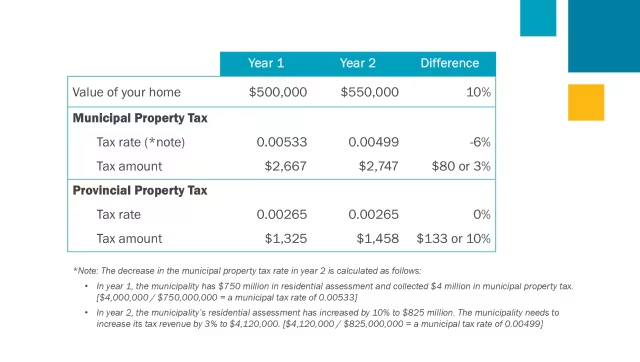
This example demonstrates that because the value of your property increased by 10 per cent:
- You will automatically pay 10 per cent, or $133, more in provincial property tax because the provincial property tax rate is fixed, like an income tax rate.
- When it comes to municipal property taxes, the percentage change in your municipal tax is more closely connected to the percentage change in how much more tax the municipality needs. In this example, you would pay 3 per cent, or $80, more in municipal property tax.
- If the municipality’s tax rate in year 1 was fixed like the province, you would have to pay $267 more in municipal property tax in year 2 instead of $80, but that isn’t how municipalities operate. An appreciation in property values isn’t treated as a source of new municipal tax revenue.
The system used by municipalities is similar to how the Government of Alberta calculated provincial property taxes prior to 2027.
In 2030, the province will set a new 3-year rate. The rate will depend on:
- How much property values grow across Alberta, and
- What portion of school costs the Alberta government wants to cover through provincial property taxes.
The Alberta government has stated that the change will not affect the budget for K-12 schools. Currently, about one-third of provincial property taxes fund school operating costs. Any shortfalls in provincial property tax will be covered through the province’s other revenues.
We have created this page of information to help municipalities and Albertans understand what the change in the provincial property tax means for them.
The change in how provincial property taxes are calculated will have an indirect impact on the financial health of municipal governments. We continue to be concerned about the lack of transparency of provincial education property taxes because municipalities have to collect the tax. Through our Property Taxes Reimagined initiative, we’re continuing to work with our 264 member municipalities to highlight the need for a reset of Alberta’s fiscal framework, which would include looking at how schools are funded.
We need constructive conversations about what level of government pays for which public services and what revenue tools each government should have to fund those public services. Among many issues, this will include research on provincial property taxes. We look forward to sharing possible solutions in 2027.
The province plans to release more information in the coming months. Questions may be emailed to the taxprogramdelivery [at] gov.ab.ca (subject: Provincial%20Education%20Property%20Tax) (Government of Alberta).

